
Start with a condition history
The choice is not simply whether repair costs less than replacement. First establish what each approach would address and what it would leave in place. A repair can be a sensible scope for limited damage. It can also be an incomplete answer when the cause extends beyond the proposed work.
Strata Los Angeles Retaining Walls offers retaining-wall repair, replacement and installation within the City of Los Angeles. We manage projects with work performed by appropriately licensed and insured contractors. We help define the work around the wall’s condition, the retained ground and the access available at the property.
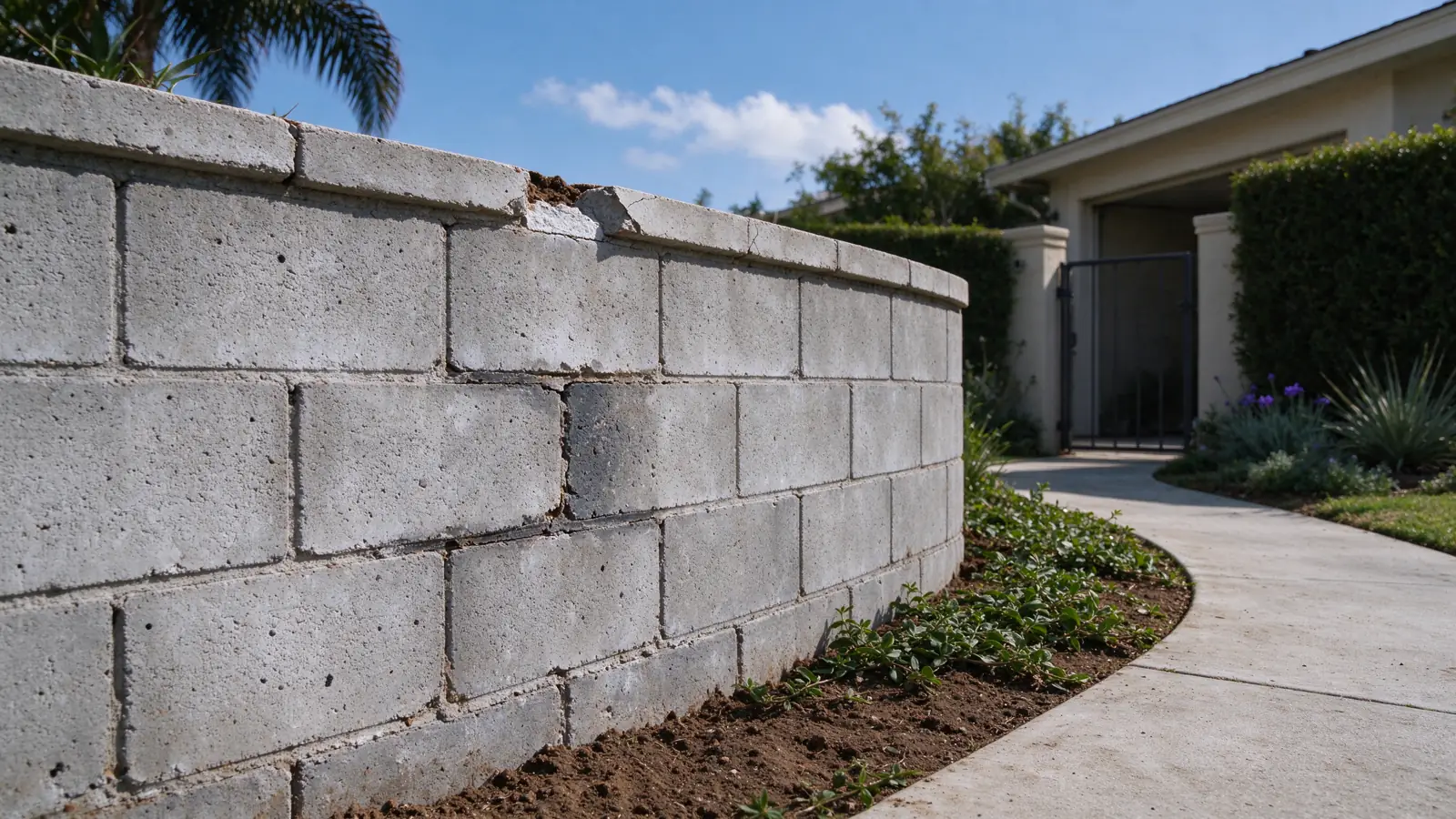
List the observations and dates before selecting an intervention. Include previous repairs, changes in the ground above the wall and any drainage observations. Keep a contractor’s recommendation separate from the evidence used to support it. When two opinions differ, the missing investigation may matter more than the price difference.
Separate local damage from a wider problem
A damaged cap, deteriorated finish and movement of a wall section are different findings. They should not all be described as “crack repair.” Ask which parts are being retained, why they are considered suitable, and what remains concealed.
A local repair should have a defined boundary and purpose. For a broader problem, that boundary may need to expand after investigation. The estimate should explain how new findings are recorded and how a revised scope is authorized.
Compare three possible scopes
| Approach | What must be established | What changes the scope |
|---|---|---|
| Localized repair | The defect is limited and the retained structure is suitable. | Movement or deterioration beyond the visible damage. |
| Partial reconstruction | The remaining wall can stay and the new section can meet it appropriately. | Interfaces, excavation access and temporary support. |
| Full replacement | The existing system cannot reasonably remain in the intended scope. | Demolition, foundation, drainage, access and restoration. |
One project, three proposals
Imagine that one bidder proposes patching the face, another rebuilding a section and another replacing the wall. Do not rank them by price until each explains the cause being addressed, the retained construction and the drainage assumptions. They may be quoting three different outcomes.
Include drainage and foundation questions
Ask where water is collected, where it discharges and which parts of that route have been verified. A proposal that mentions drainage without defining the work leaves a major comparison unresolved. Similarly, distinguish known foundation construction from assumed construction.
The investigation should match the question being asked. Existing records, visual inspection and any proposed exploratory work provide different kinds of evidence. A photograph of the front face does not establish the condition of everything behind it.
Make uncertainty visible
Ask every bidder to list concealed conditions, exclusions and allowances. What happens if the retained section is unsuitable? What happens if the outlet is not where expected? Is removal and restoration of surrounding paving included? The answers help define the project’s financial uncertainty without pretending it can be eliminated in advance.
Keep these items alongside the base price. A lower starting figure with substantial excluded work may not be the smaller project. A more extensive intervention also needs a clear justification; a larger scope is not automatically a better one.
Compare disruption as well as scope
Consider daily access, material handling, protection of adjacent areas and the surfaces to be restored. If the property remains occupied, the work sequence belongs in the discussion. Do not replace these practical questions with an unsupported promise that a particular repair will last a fixed number of years.
Before accepting a proposal
- Can I identify the finding behind the recommendation?
- Do I know what construction remains?
- Are drainage and restoration defined?
- Are design and permitting responsibilities assigned?
- Is there a written process for concealed conditions?
For the service scope and the information to send with an inquiry, see retaining-wall repair in Los Angeles.
Questions before you decide
Is replacement always the safer choice?
A larger scope is not automatically the right scope. The recommendation should follow the assessed conditions and the intended use. Ask why retained construction is suitable or unsuitable, and what evidence supports that conclusion.
How do I compare quotes with different assumptions?
List the retained wall, drainage work, excavation, restoration and concealed conditions for each quote. Ask the bidders to reconcile the differences before treating the totals as comparable. The cost guide provides a price-scope checklist.
Does a cheap patch buy useful time?
That depends on the condition and the purpose of the patch. A surface treatment should not be described as structural stabilization without a supported design. Ask what the work accomplishes and what problem remains after it.
Bring the decision back to your property
Write down the result you need before choosing between proposals. Is the immediate issue an isolated damaged area, a wall whose movement needs investigation, or a new use of the ground above it? A proposal that solves a different problem can be detailed and still be wrong for your objective.
For a useful first discussion, Strata offers retaining-wall repair in Los Angeles. The complete planning guide explains how material, slope and drainage affect the system. Keep the investigation findings with the estimate so the eventual choice has a documented basis.
Continue planning your wall
Retaining-wall repair · Repair or replacement · Local costs · Complete planning guide · Hollywood Hills